Hardware Setup
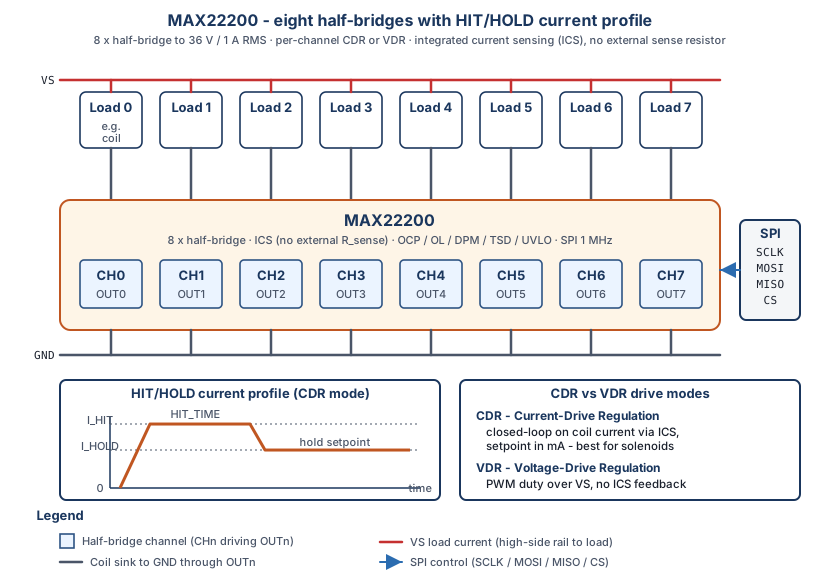
This guide covers the physical connections and hardware requirements for the MAX22200 octal solenoid and motor driver chip.
Pin Connections
Basic SPI Connections
1
2
3
4
5
6
7
8
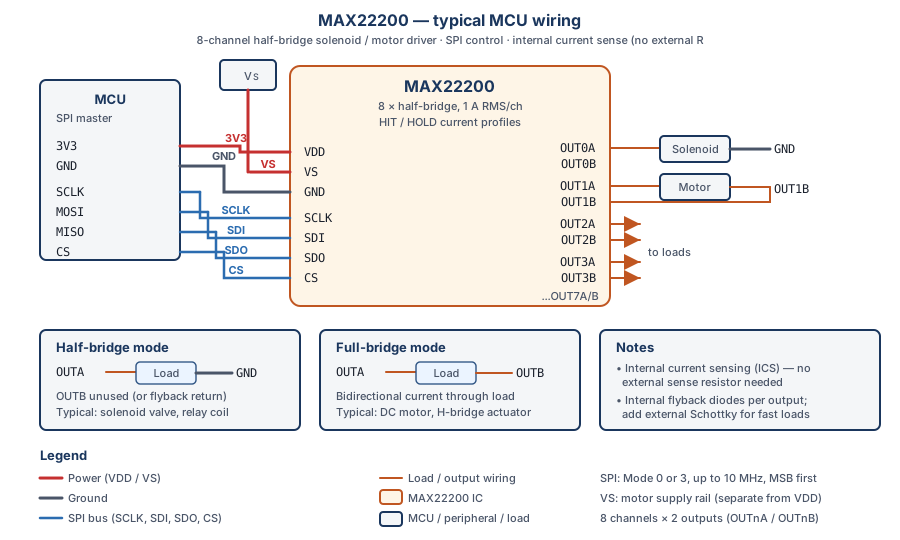
MCU              MAX22200
─────────────────────────
3.3V      ────── VDD
GND       ────── GND
SCK       ────── SCLK
MOSI      ────── SDI
MISO      ────── SDO
CS        ────── CS
Pin Descriptions
| Pin | Name | Description | Required |
|---|---|---|---|
| VDD | Power | 3.3V power supply (2.7V - 5.5V) | Yes |
| GND | Ground | Ground reference | Yes |
| SCLK | Clock | SPI clock line | Yes |
| SDI | Data In | SPI data input (from MCU) | Yes |
| SDO | Data Out | SPI data output (to MCU) | Yes |
| CS | Chip Select | SPI chip select (active low) | Yes |
| FAULT | Fault | Fault interrupt output (optional) | No |
| RESET | Reset | Reset input (optional) | No |
Channel Output Pins
Each of the 8 channels has two output pins:
| Channel | OUTA | OUTB |
|---|---|---|
| 0 | OUT0A | OUT0B |
| 1 | OUT1A | OUT1B |
| 2 | OUT2A | OUT2B |
| 3 | OUT3A | OUT3B |
| 4 | OUT4A | OUT4B |
| 5 | OUT5A | OUT5B |
| 6 | OUT6A | OUT6B |
| 7 | OUT7A | OUT7B |
Power Requirements
- Supply Voltage: 2.7V - 5.5V (3.3V or 5V typical)
- Current Consumption: Depends on load, up to 1A RMS per channel
- Power Supply: Clean supply with decoupling capacitors (100nF ceramic + 10µF tantalum recommended per channel)
SPI Configuration
- Mode: SPI Mode 0 (CPOL=0, CPHA=0) or Mode 3 (CPOL=1, CPHA=1)
- Speed: Up to 10 MHz
- Bit Order: MSB first
- CS Polarity: Active low (CS)
- Data Format: 8-bit data words
Load Connections
Half-Bridge Mode
In half-bridge mode, connect the load between OUTA and GND:
1
2
OUTA ────[Load]──── GND
OUTB ──── (not used)
Full-Bridge Mode
In full-bridge mode, connect the load between OUTA and OUTB:
1
OUTA ────[Load]──── OUTB
Physical Layout Recommendations
- Keep SPI traces short (< 10cm recommended)
- Use ground plane for noise reduction
- Place decoupling capacitors (100nF ceramic + 10µF tantalum) close to VDD pin
- Route clock and data lines away from noise sources
- Keep high-current traces (OUTA/OUTB) away from sensitive signals
- Use appropriate trace widths for high-current paths
- Add flyback diodes for inductive loads (solenoids, motors)
Example Wiring Diagram
1
2
3
4
5
6
7
8
9
10
11
12
13
14
                    MAX22200
                    ┌─────────┐
        3.3V ───────┤ VDD     │
        GND  ───────┤ GND     │
        SCK  ───────┤ SCLK    │
        MOSI ───────┤ SDI     │
        MISO ───────┤ SDO     │
        CS   ───────┤ CS      │
                    └─────────┘
                      │
                      │ OUT0A
                      ├───[Solenoid]─── GND
                      │
                      │ OUT0B (not used in half-bridge)
Protection Components
Flyback Diodes
For inductive loads (solenoids, motors), add flyback diodes:
1
2
OUTA ────[Flyback Diode]─── OUTB
         (cathode to OUTA)
Current Limiting
The MAX22200 has built-in overcurrent protection (OCP), but you may want to add external current limiting for additional safety.
Next Steps
- Verify connections with a multimeter
- Proceed to Quick Start to test the connection
- Review Platform Integration for software setup
Navigation ⬅️ Quick Start | Next: Platform Integration ➡️ | Back to Index