HF-TMC51x0 Driver (TMC5130 & TMC5160)
C++17 hardware-agnostic driver for Trinamic TMC51x0 stepper motor controllers (TMC5130 & TMC5160) with advanced features



📚 Table of Contents
- Overview
- Features
- Quick Start
- Installation
- API Reference
- Examples
- Documentation
- Contributing
- License
📦 Overview
📖 📚🌐 Live Complete Documentation - Interactive guides, examples, and step-by-step tutorials
HF-TMC51x0 is a comprehensive, production-ready C++17 driver for the Trinamic TMC51x0 stepper motor controller ICs (TMC5130 & TMC5160). The TMC51x0 family includes sophisticated stepper motor drivers supporting advanced features including stealthChop for silent operation, spreadCycle for high torque, StallGuard2 for stall detection, and encoder support for closed-loop control.
This driver provides complete feature coverage of all 47 TMC51x0 registers with 100+ public API methods organized into intuitive, well-structured subsystems. It supports multi-chip communication via SPI daisy chaining and UART multi-node addressing, physical unit conversions (mm, degrees, RPM, belt teeth), automatic parameter tuning, sensorless homing, and many other advanced features not found in other TMC51x0 drivers. The driver automatically detects and supports both TMC5130 and TMC5160 chips.
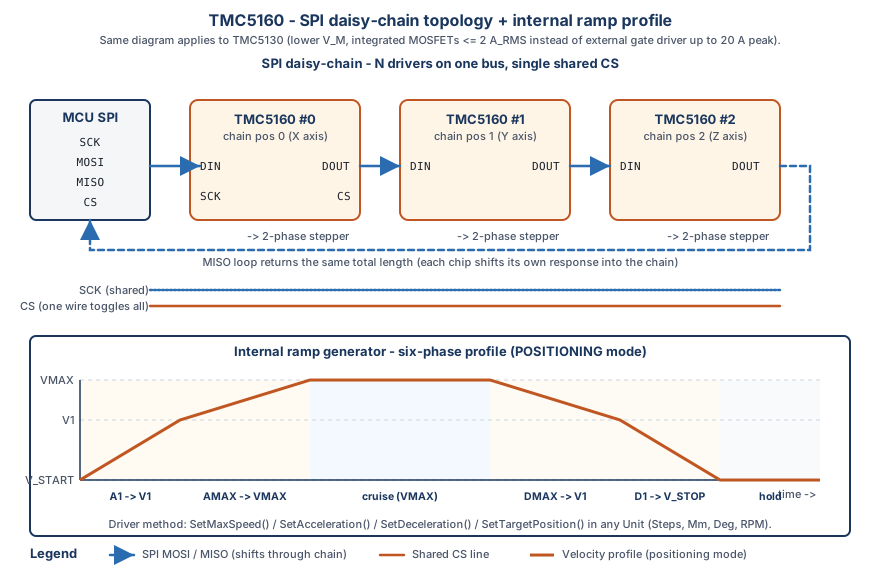
Architecture & Design
The driver is built with a subsystem-based architecture that organizes functionality into logical groups, making it easy to find and use the features you need:
1
2
3
4
5
6
7
8
9
10
11
12
13
14
15
16
17
tmc51x0::TMC51x0<MySPI> driver(spi);

// Organized subsystems for intuitive access
driver.rampControl      // Motion planning, positioning, and velocity control
driver.motorControl     // Current control, chopper modes, StealthChop
driver.switches         // Reference switches / endstops
driver.thresholds       // Mode-change speed thresholds (StealthChop, CoolStep, high-speed)
driver.stallGuard       // StallGuard2 reading, stop-on-stall
driver.status           // Driver status, diagnostics, temperature, open-load detection
driver.tuning           // Automatic StallGuard2 threshold optimization
driver.homing           // Sensorless, switch-based, and encoder homing; bounds finding
driver.encoder          // ABN encoder integration and deviation detection
driver.powerStage       // Short-circuit and overtemperature protection
driver.communication    // Clock, SPI daisy-chain, UART node addressing
driver.io               // IOIN register, operating mode pins
driver.events           // X_COMPARE position events
driver.printer          // Debug register printing (GCONF, DRV_STATUS, etc.)
The driver uses CRTP (Curiously Recurring Template Pattern) for hardware-agnostic communication interfaces, allowing it to run on any platform (ESP32, STM32, Arduino, Raspberry Pi, etc.) with SPI or UART. This design provides zero runtime overhead while maintaining complete platform independence.
Key Capabilities
- Complete Register Coverage: All 47 TMC51x0 registers (0x00-0x73) accessible through type-safe C++ API
- Multi-Chip Support: SPI daisy chaining and UART multi-node addressing for controlling multiple motors
- Unit Conversions: Work with physical units (mm, degrees, RPM) instead of raw steps
- Automatic Tuning: Intelligent StallGuard2 threshold optimization with velocity range analysis
- Sensorless Homing: Endstop-free homing using StallGuard2 stall detection
- Dual Chip Support: Automatically detects and supports both TMC5130 and TMC5160 chips
- Modern C++17: Type-safe API with RAII principles and compile-time optimizations
🔀 Chip Compatibility
The driver targets the entire TMC51x0 family with a single class. Chip-specific features
degrade gracefully with ErrorCode::UNSUPPORTED when called on a chip that lacks them.
| Feature | TMC5130 | TMC5160 |
|---|---|---|
| Internal motion controller (ramp gen) | ✅ | ✅ |
| StealthChop2 / SpreadCycle / CoolStep | ✅ | ✅ |
| StallGuard2 sensorless load detection | ✅ | ✅ |
| ABN encoder + index homing | ✅ | ✅ |
| SPI daisy-chain / UART multi-node | ✅ | ✅ |
| Integrated MOSFETs (≤ 2 A_RMS) | ✅ | — |
| External gate driver (≤ 20 A peak) | — | ✅ |
| Higher V_M range | up to 46 V | up to 60 V |
| Short-to-supply / short-to-GND protect | basic | advanced (S2VS / S2G levels) |
| Power-stage configuration (DRV_CONF) | limited | full |
Chip detection is automatic during Initialize(). See
docs/tmc5130_support.md for the complete differences list.
✨ Features
🎯 Core Motor Control
RampControl Subsystem
- ✅ Positioning Mode: Precise position control with configurable acceleration profiles
- ✅ Velocity Mode: Continuous motion in positive or negative direction
- ✅ Hold Mode: Maintain position with configurable hold current
- ✅ Advanced Ramp Profiles: Multi-phase acceleration (A1, AMAX, D1) for smooth motion
- ✅ Reference Switches: Configurable endstops with latching and stop-on-switch modes
- ✅ Unit-Aware API: Set positions, speeds, and accelerations in steps, mm, degrees, RPM, or revolutions per second (RevPerSec - default for velocities)
MotorControl Subsystem
- ✅ Current Control: Automatic calculation from motor specifications (rated current, sense resistor)
- ✅ Run/Hold Currents: Independent run and hold current settings with global scaler
- ✅ Chopper Modes:
- spreadCycle: High torque mode with configurable chopper settings
- stealthChop: Silent operation with automatic PWM amplitude scaling
- ✅ Mode Switching: Automatic switching between stealthChop and spreadCycle based on velocity
- ✅ Freewheeling: Automatic freewheeling when motor is stopped
🔍 Diagnostics & Tuning
Status Subsystem (driver.status)
- ✅ Status Monitoring: Comprehensive driver status (overtemperature, short circuit, etc.)
- ✅ Open Load Detection: Detect interrupted cables or connector issues
- ✅ Lost Steps Counter: Monitor step loss during operation
- ✅ Setup Verification: Comprehensive startup verification and diagnostics (
VerifySetup())
StallGuard Subsystem (driver.stallGuard)
- ✅ StallGuard2 Reading: Real-time load measurement (0-1023) for diagnostics
- ✅ Stop on Stall: Configure automatic stop when stall is detected
- ✅ Soft Stop: Deceleration ramp on stall instead of hard stop
Tuning Subsystem (driver.tuning)
- ✅ Automatic SGT Tuning: Intelligent StallGuard2 threshold optimization
- ✅ Velocity Range Analysis: Finds optimal SGT for target velocity with min/max range testing
- ✅ Comprehensive Results: Returns detailed tuning results including actual achievable velocities
- ✅ Target Velocity Priority: Optimizes SGT primarily for your most important operating speed
🏠 Homing & Positioning
Homing Subsystem (driver.homing)
- ✅ Sensorless Homing: Endstop-free homing using StallGuard2 stall detection
- ✅ Switch-Based Homing: Homing using reference switches/endstops
- ✅ Encoder Index Homing: Homing to encoder N-channel index pulse
- ✅ Bounds Finding: Detect mechanical limits and home to center, min, or max (
FindBounds()) - ✅ Automatic Settings Caching: Preserves and restores driver settings during homing
- ✅ Cancel Callback: Abort homing mid-operation via user-provided callback
🔄 Encoder Integration
Encoder Subsystem
- ✅ Closed-Loop Control: Encoder feedback for position verification
- ✅ Deviation Detection: Monitor and detect position deviation (step loss)
- ✅ Automatic Compensation: Optional automatic position correction
- ✅ Encoder Configuration: Flexible encoder setup (AB, ABZ, SPI, etc.)
🛡️ Protection Systems
PowerStage Subsystem (driver.powerStage)
- ✅ Short Circuit Protection: Configurable S2VS and S2G voltage thresholds
- ✅ Power Stage Configuration: MOSFET drive strength, break-before-make timing
- ✅ Overtemperature Protection: Automatic shutdown on overtemperature (monitored via
driver.status)
🔗 Multi-Chip Communication
Communication Subsystem
- ✅ SPI Daisy Chaining: Connect multiple TMC51x0 chips on a single SPI bus
- Automatic chain length detection
- Position-based addressing (0, 1, 2, …)
TMC51x0DaisyChainhelper class for easy management
- ✅ UART Multi-Node: Support for up to 255 devices on a single UART bus
- Node addressing (0-254)
- Sequential programming support
TMC51x0MultiNodehelper class for multi-device management
- ✅ Automatic Detection: Chip version detection (TMC5130 vs TMC5160)
⚙️ Advanced Features
- ✅ CoolStep: Automatic current reduction when load is low for power efficiency
- ✅ dcStep: Automatic commutation for DC motor-like operation
- ✅ Microstep Lookup Tables: Custom microstep interpolation for optimized motion profiles
- ✅ Unit Conversions: Physical unit support (millimeters, degrees, RPM, belt teeth)
- Lead screw systems (mm pitch)
- Belt drive systems (belt pitch, pulley teeth)
- Direct drive and gearbox systems
- ✅ OTP Programming: One-time programmable memory read/write support
- ✅ Factory Configuration: Read factory calibration and configuration data
- ✅ Motor Setup from Specs: High-level configuration from physical motor parameters
🏗️ Platform & Architecture
- ✅ Hardware Agnostic: SPI or UART interface for complete platform independence
- ✅ CRTP Design: Zero-overhead compile-time polymorphism
- ✅ Template-Based: Type-safe API with compile-time optimizations
- ✅ Modern C++17: RAII principles, constexpr functions, type safety
- ✅ Complete Register Coverage: All 47 registers (0x00-0x73) with 100+ public API methods
- ✅ Subsystem Organization: Logical grouping of functionality for easy discovery
🚀 Quick Start
1
2
3
4
5
6
7
8
9
10
11
12
13
14
15
16
17
18
19
20
21
22
23
24
25
26
27
28
29
30
31
32
#include "inc/tmc51x0.hpp"

// 1. Implement the SPI/UART communication interface for your platform.
//    See docs/platform_integration.md for full ESP32/STM32/Arduino templates.
class MySPI : public tmc51x0::SpiCommInterface<MySPI> {
public:
    tmc51x0::Result<void> SpiTransfer(const uint8_t* tx, uint8_t* rx, size_t length) noexcept;
    tmc51x0::Result<void> GpioSet(tmc51x0::TMC51x0CtrlPin pin, tmc51x0::GpioSignal sig) noexcept;
    tmc51x0::Result<tmc51x0::GpioSignal> GpioRead(tmc51x0::TMC51x0CtrlPin pin) noexcept;
    void DelayMs(uint32_t ms) noexcept;
    void DelayUs(uint32_t us) noexcept;
protected:
    void DebugLog(int level, const char* tag, const char* fmt, va_list args) noexcept;
};

// 2. Create driver instance
MySPI spi;
tmc51x0::TMC51x0<MySPI> driver(spi);

// 3. Initialize from motor spec — IRUN, IHOLD, and GLOBAL_SCALER are auto-calculated
tmc51x0::DriverConfig cfg{};
cfg.motor_spec.rated_current_ma   = 2000;   // 2 A rated current
cfg.motor_spec.sense_resistor_mohm = 50;    // 0.05 Ω sense resistor
cfg.motor_spec.supply_voltage_mv  = 24000;  // 24 V supply
if (auto r = driver.Initialize(cfg); !r) { /* handle r.ErrorMessage() */ return; }

// 4. Enable and run a positioning move
driver.motorControl.Enable();
driver.rampControl.SetRampMode(tmc51x0::RampMode::POSITIONING);
driver.rampControl.SetMaxSpeed(60.0f, tmc51x0::Unit::RPM);
driver.rampControl.SetAcceleration(5.0f, tmc51x0::Unit::RevPerSec);
driver.rampControl.SetTargetPosition(180.0f, tmc51x0::Unit::Deg);   // move to 180°
For a fully-stubbed MySPI template plus daisy-chain, units, and Result<T> patterns,
see docs/quickstart.md, docs/platform_integration.md,
and the Multi-chip / Units / Error-handling cookbook.
Result<T>pattern: every method returns a lightweightResult<T>carrying either a value or anErrorCode(no exceptions). Check withif (auto r = ...; !r)orr.IsOk(). Full code list andValue()/ValueOr()patterns are in docs/troubleshooting.md. Quick Start above omits checks for brevity — production code should always inspect the result.
🔧 Installation
- Clone or copy the driver files into your project
- Implement the communication interface for your platform (see Platform Integration)
- Include the header in your code:
1
#include "inc/tmc51x0.hpp"
- Compile with a C++17 or newer compiler
For detailed installation instructions, see docs/installation.md.
📖 API Reference
All methods return
Result<T>types. Check withIsOk()/operator boolbefore usingValue(). See the full API Reference for complete signatures and return types, and docs/troubleshooting.md for the fullErrorCodelist.
Class Structure & Subsystems
The TMC51x0 class is organized into intuitive subsystems for easy access to functionality:
1
2
3
4
5
6
7
8
9
10
11
12
13
14
15
16
17
18
19
20
21
22
23
24
25
26
27
28
29
30
31
32
33
34
35
36
37
38
39
40
41
42
43
44
45
46
47
48
49
50
51
tmc51x0::TMC51x0<MySPI> driver(spi);
using Unit = tmc51x0::Unit;
using Homing = tmc51x0::TMC51x0<MySPI>::Homing;

// --- Motion Control ---
driver.rampControl.SetRampMode(tmc51x0::RampMode::POSITIONING);
driver.rampControl.SetMaxSpeed(60.0f, Unit::RPM);
driver.rampControl.SetAcceleration(5.0f, Unit::RevPerSec);
driver.rampControl.SetDeceleration(5.0f, Unit::RevPerSec);
driver.rampControl.SetTargetPosition(180.0f, Unit::Deg);

// --- Motor Control ---
driver.motorControl.Enable();
driver.motorControl.SetCurrent(20, 10);              // IRUN=20, IHOLD=10
driver.motorControl.SetStealthChopEnabled(true);      // Silent mode

// --- Diagnostics & Monitoring ---
auto status = driver.status.GetStatus();               // DriverStatus struct
auto sg = driver.stallGuard.GetStallGuardResult();     // StallGuard2 value (0-1023)
driver.status.VerifySetup();                           // Comprehensive startup check

// --- Automatic Tuning ---
tmc51x0::StallGuardTuningResult tune_result;
driver.tuning.AutoTuneStallGuard(
    30.0f, tune_result, -20, 20,                       // target RPM, SGT range
    5.0f, 0.0f, 0.0f,                                  // accel, min/max velocity
    Unit::RPM, Unit::RevPerSec, 0.3f);                  // units, current reduction

// --- Bounds Finding (searches for mechanical limits, homes to center) ---
Homing::BoundsOptions opt{};
opt.speed_unit = Unit::RPM;
opt.position_unit = Unit::Deg;
opt.search_speed = 30.0f;
opt.search_span = 360.0f;
opt.timeout_ms = 10000;
opt.search_accel = 5.0f;
opt.accel_unit = Unit::RevPerSec;

Homing::HomeConfig home{};
home.mode = Homing::HomePlacement::AtCenter;
auto bounds = driver.homing.FindBounds(Homing::BoundsMethod::StallGuard, opt, home);

// --- Encoder Integration ---
tmc51x0::EncoderConfig enc_cfg{};
driver.encoder.Configure(enc_cfg);
driver.encoder.SetResolution(200, 4096, false);        // 200 steps/rev, 4096 PPR encoder
driver.encoder.SetAllowedDeviation(100);               // 100-step deviation threshold

// --- Power Stage / Protection ---
tmc51x0::PowerStageParameters ps_cfg{};
driver.powerStage.ConfigureShortProtection(ps_cfg);
Key Methods by Subsystem
RampControl Subsystem
| Method | Description |
|——–|————-|
| SetRampMode() | Set mode: POSITIONING, VELOCITY_POS, VELOCITY_NEG, HOLD |
| SetTargetPosition() | Set target position (unit-aware: Steps, Mm, Deg, RPM) |
| SetMaxSpeed() | Set maximum velocity (unit-aware) |
| SetAcceleration() | Set acceleration/deceleration (unit-aware) |
| IsTargetReached() | Check if position target reached |
| Stop() | Stop motor immediately |
Switches Subsystem
| Method | Description |
|——–|————-|
| ConfigureReferenceSwitch() | Configure endstops/reference switches |
Thresholds Subsystem
| Method | Description |
|——–|————-|
| SetModeChangeSpeeds() | Convenience setter for TPWMTHRS/TCOOLTHRS/THIGH |
PowerStage Subsystem
| Method | Description |
|——–|————-|
| ConfigurePowerStage() | Configure DRV_CONF (power MOSFET drive, BBM, OT) |
| ConfigureShortProtection() | Configure SHORT_CONF levels (short protection) |
MotorControl Subsystem (driver.motorControl)
| Method | Description |
|——–|————-|
| Enable() / Disable() | Enable/disable motor driver |
| SetCurrent() | Set run and hold currents (IRUN, IHOLD) |
| SetStealthChopEnabled() | Enable/disable silent StealthChop mode |
| ConfigureChopper() | Configure SpreadCycle chopper settings |
| ConfigureStealthChop() | Configure StealthChop PWM settings |
| ConfigureMotorCurrent() | Auto-calculate current from motor specs |
StallGuard Subsystem (driver.stallGuard)
| Method | Description |
|——–|————-|
| GetStallGuardResult() | Read StallGuard2 value (0-1023) |
| ConfigureStallGuard() | Configure StallGuard2 threshold and filter |
| EnableStopOnStall() | Enable/disable automatic stop on stall |
| IsStallDetected() | Check if stall event was detected |
Status Subsystem (driver.status)
| Method | Description |
|——–|————-|
| GetStatus() | Get comprehensive driver status struct |
| GetGlobalStatus() | Read GSTAT (reset, drv_err, uv_cp) |
| IsOpenLoadA() / IsOpenLoadB() | Check for open load conditions |
| IsOvertemperature() | Check overtemperature flag |
| GetLostSteps() | Read lost steps counter |
| VerifySetup() | Run comprehensive startup verification |
Tuning Subsystem (driver.tuning)
| Method | Description |
|——–|————-|
| AutoTuneStallGuard() | Automatic SGT tuning with current reduction (recommended) |
| TuneStallGuard() | SGT tuning with velocity range analysis |
| Both return results via StallGuardTuningResult | Optimal SGT, velocity compatibility, achievable velocities |
Homing Subsystem (driver.homing)
| Method | Description |
|——–|————-|
| FindBounds() | Find mechanical limits and home (StallGuard, encoder, or switch) |
| FindBoundsStallGuard() | Bounds finding using StallGuard2 specifically |
| PerformSensorlessHoming() | Single-direction sensorless homing |
| PerformSwitchHoming() | Homing using reference switches |
| PerformEncoderIndexHoming() | Homing to encoder N-channel index |
Encoder Subsystem (driver.encoder)
| Method | Description |
|——–|————-|
| Configure() | Configure encoder settings |
| SetResolution() | Set motor steps, encoder PPR, invert direction |
| SetAllowedDeviation() | Set deviation threshold for step loss detection |
| GetPosition() | Read encoder position |
| IsDeviationWarning() | Check if deviation threshold exceeded |
PowerStage Subsystem (driver.powerStage)
| Method | Description |
|——–|————-|
| ConfigureShortProtection() | Configure short circuit protection (S2VS, S2G) |
| ConfigurePowerStage() | Configure MOSFET drive strength and BBM |
Thresholds Subsystem (driver.thresholds)
| Method | Description |
|——–|————-|
| SetModeChangeSpeeds() | Set StealthChop/CoolStep/high-speed thresholds |
| SetStealthChopVelocityThreshold() | Set TPWMTHRS threshold |
| SetModeHysteresis() | Configure hysteresis for smooth mode transitions |
Communication Subsystem (driver.communication)
| Method | Description |
|——–|————-|
| SetDaisyChainPosition() | Set SPI daisy chain position |
| ConfigureUartNodeAddress() | Configure UART node address and send delay |
| SetClkFreq() | Set clock frequency |
Multi-Chip Support
| Class/Method | Description |
|---|---|
TMC51x0DaisyChain<CommType, MaxDevices> |
High-level manager for SPI daisy chaining |
TMC51x0MultiNode<CommType> |
High-level manager for UART multi-node addressing |
chain[0], chain[1], … |
Access individual drivers in chain |
Unit Conversion Helpers
| Function | Description |
|---|---|
MmToSteps() / StepsToMm() |
Convert between millimeters and steps |
RpmToStepsPerSec() / StepsPerSecToRpm() |
Convert between RPM and steps/s |
Default Units: Velocity functions default to Unit::RevPerSec (revolutions per second) for user-friendly operation |
|
DegreesToSteps() / StepsToDegrees() |
Convert between degrees and steps |
For complete API documentation with all methods and parameters, see docs/api_reference.md.
📊 Examples
Comprehensive ESP32 examples are available in examples/esp32/main/, demonstrating all major features. Build and flash using the project scripts (see examples/esp32/README.md).
Comprehensive Test Suite
internal_ramp_comprehensive_test.cpp– Main test suite covering core init, motor control, ramp control, StealthChop, StallGuard2, encoder, reference switches, diagnostics, and protection in one integrated test
Motion Control
internal_ramp_sinusoidal.cpp– Back-and-forth positioning withBackAndForthMotionclass, configurable viaSELECTED_TEST_RIGfatigue_test_espnow/main.cpp– Production fatigue test: bounds finding, point-to-point motion, ESP-NOW remote control, UART console
Tuning & Homing
stallguard_tuning.cpp– Automatic StallGuard2 threshold (SGT) tuning withAutoTuneStallGuard()bounds_finding_test.cpp– Standalone bounds finding: searches for mechanical limits, homes to center
Multi-Chip Communication
spi_daisy_chain_comprehensive_test.cpp– SPI daisy chain setup and multi-motor coordination (2+ drivers required)uart_multi_node_comprehensive_test.cpp– UART multi-node addressing (placeholder implementation)
Sensors & Diagnostics
abn_encoder_reader.cpp– Continuous ABN encoder position reading
All examples use a unified test rig selection (SELECTED_TEST_RIG) for compile-time motor/board/platform configuration. See docs/examples.md for detailed walkthroughs.
📚 Documentation
Complete Documentation on GitHub Pages
Getting Started
| Guide | Description |
|---|---|
| Quick Start | Minimal working example, Result<T> primer, subsystem overview |
| Installation | Cloning, compiler requirements, include paths |
| Hardware Setup | Wiring, power supply, sense resistors |
| Platform Integration | Implementing MySPI / MyUART for your board (ESP32, STM32, Arduino) |
Reference
| Guide | Description |
|---|---|
| API Reference | Complete method signatures, return types, and parameters |
| Configuration | DriverConfig fields, chopper tuning, StealthChop parameters |
| Examples | Progressively harder walkthroughs with explanations |
| Error Handling | Result<T>, ErrorCode, common patterns |
| Troubleshooting | Error codes, common failures, recovery strategies |
Advanced Features
| Guide | Description |
|---|---|
| Sensorless Homing | StallGuard2 homing and bounds finding |
| Advanced Configuration | CoolStep, dcStep, StealthChop tuning |
| Multi-Chip Communication | SPI daisy chain and UART multi-node |
| GPIO Pin Configuration | DIAG0/DIAG1, STEP/DIR, reference switches |
| TMC5130 Support | Differences from TMC5160, compatibility notes |
For local browsing, see the docs directory.
🔗 References
| Resource | Link |
|---|---|
| Trinamic TMC5160 product page | https://www.analog.com/en/products/tmc5160.html |
| Trinamic TMC5130 product page | https://www.analog.com/en/products/tmc5130.html |
| TMC5160 datasheet (ADI/Trinamic) | https://www.analog.com/media/en/technical-documentation/data-sheets/tmc5160_datasheet.pdf |
| TMC5130 datasheet (ADI/Trinamic) | https://www.analog.com/media/en/technical-documentation/data-sheets/tmc5130_datasheet.pdf |
| StallGuard2 / CoolStep / StealthChop2 application notes | https://www.analog.com/en/products/landing-pages/001/trinamic-application-notes.html |
| ESP-IDF SPI / UART | https://docs.espressif.com/projects/esp-idf/en/stable/esp32/api-reference/peripherals/index.html |
| C++17 language reference | https://en.cppreference.com/w/cpp/17 |
🤝 Contributing
Pull requests and suggestions are welcome! Please follow the existing code style and include tests for new features.
📄 License
This project is licensed under the GNU General Public License v3.0. See the LICENSE file for details.